
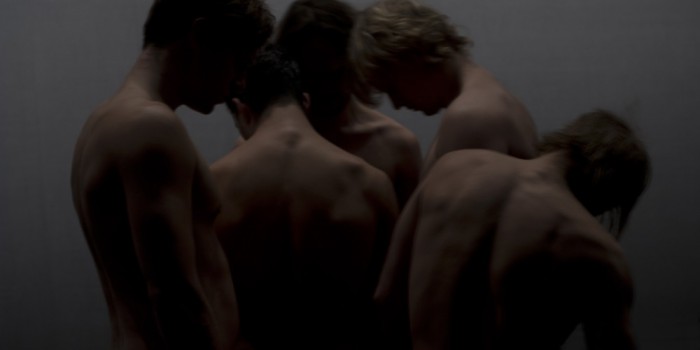
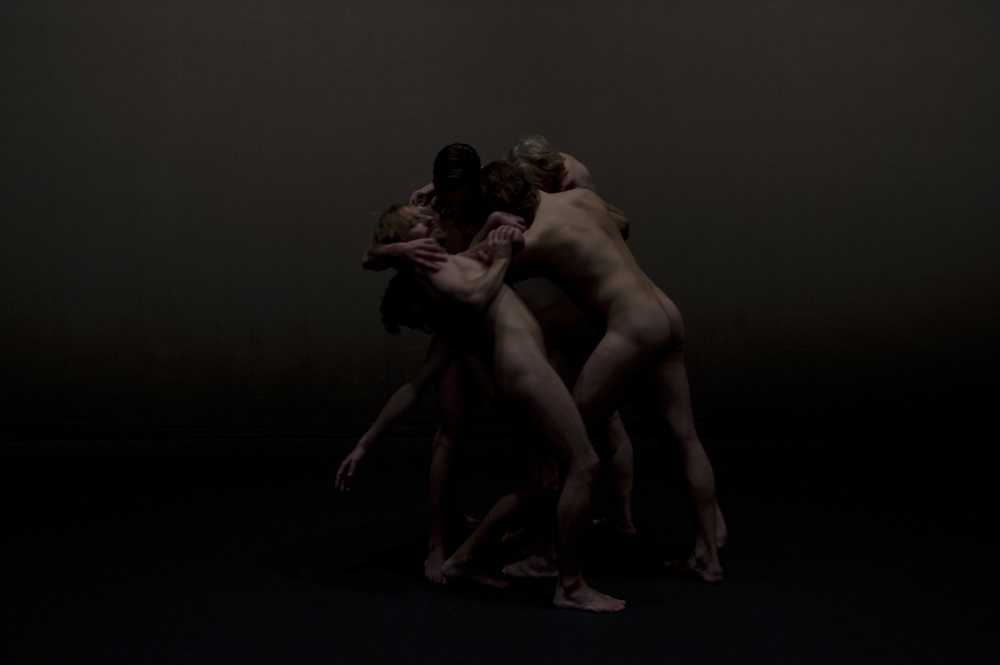
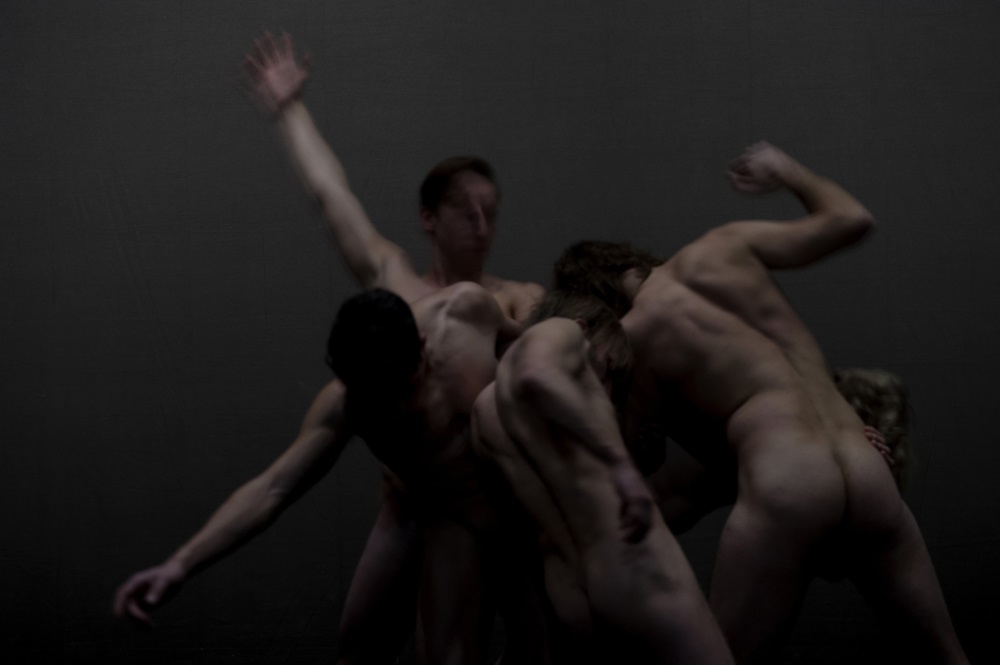
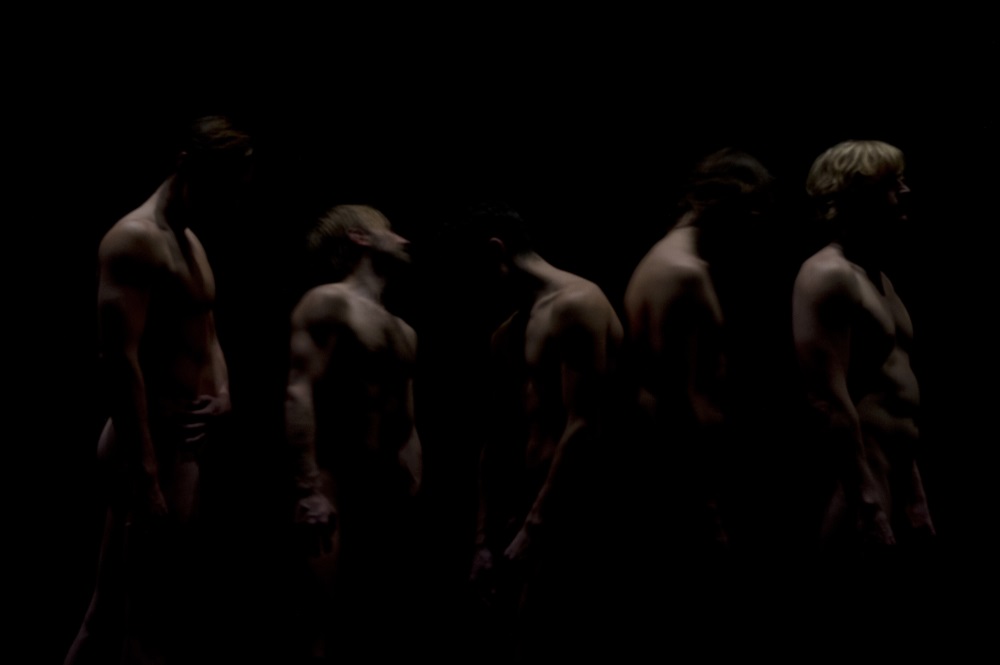
“Memento Mori” has no other subject than movement in itself. Or more precisely the moment which precedes movement. I mean the very start, the initial moment, just before any sign of something moving. One would listen; one would hear some deep remote rumbling rising, drawing near, and they would appear: naked. One would conjure up all the images one carries deep inside and which belong to each individual, but which also belong to the high Aurignacian or even to earlier times to a prelapsary world. Naked. Before the fall. Before the fault. Do the pictures on the cave walls dance? Do the hands on the cave walls dance? Yes indeed. They dance under the light. What is movement but substance changing from an former shape to a new one and light allows this transformation. Yes, light allows this when it enters into the cave. The obscure cave of the brain; disclosing primary forms of joy, of dazzling rapture, when the Dionysian world of fruit! Grapes! Bananas! Tomatoes and garden come out and join the bodies! Dionysius everywhere! …just before terror. Dead scared to be alive; or afraid of losing life. Before they start licking one another, again and again; all of them; licking every single part of their bodies clean. And licking, licking endlessly, licking clean, cleaning life, cleaning the pictures we have of ourselves.
Pascal Rambert (Paris, september 2011)
Conception, direction – Pascal Rambert
Artistic collaboration, stage device and light – Yves Godin
Original Music – Alexandre Meyer
With 5 performers – Elmer B?ck, Rasmus Slatis, Jakob Ohrman & Lorenzo De Angelis
Stage manager – Tristan Mengin
Production manager – Pauline Roussille
Production: Th??tre de Gennevilliers Centre Dramatique National de Cr?ation Contemporaine
Coproduction: CDC – Les Hivernales en Avignon
Th??tre de Gennevilliers is subsidized by the Cultural and Communication government department, the city of Gennevilliers and the Hauts-de-Seine general council.

Yves Godin, Artistic collaboration, stage device and light
Yves Godin collaborated as a stage-light creator to the projects of many choreographers in the early 90s (Herv? Robe, Georges Appaix, Fattoumi and Lamoureux), discovering thus a large field of aesthetic experiments. Then he worked with several musicians, visual artists and choreographers (particularly with Alain Chamard, Kasper Toeplitz, Rachid Oumradane, Julie Nioche, Emmanuelle Huynh, Boris Charmatz, Claude Wampler, Christian Sebille, Maria Donata d’Urso, Jennifer Lacey and Nadia Lauro, Alain Buffard, Vincent Dupont). He conceives the light as independent from dance music or text and yet as a suitable complementary element to the other elements of the scenic art. His two major work directions are the perception of space and time, weaving networks which can be more or less anachronistic with the other elements (bodies, sounds, thought, time). Today he collaborates essentially with Vincent Dupont and Boris Charmatz. Besides, Yves Godin created the lights for the “Legend“ exhibition in Domaine de Chamarande, for the opening of LIFE (ST Nazaire, 2008) with “life light”, as well as for the happening ?trangler le temps (strangle time), a prefiguration of the Mus?e de la danse , april 2009, with the light creation “fiat lux for a Volkswagen garage”. He also took part in the zero exhibition of the Mus?e de la danse in LIFE (ST Nazaire, 2009).
Since 2008 with “Point d’orgue”, a disposition for 1000candles, he has invited performers to visit his installation.
Alexandre Meyer, music
Born in 1962, he has been in many groups since 1982: Loupideloupe, Les Trois 8, Sentimental trios 8. He works with Marc Citti, Fred Costa, Fr?d?ric Mini?re, Xavier Garcia, Heiner Goebbels the stage directors Cl?mentine Baert, Maurice B?nichou, Patrick Bouchain, Robert Cantarella, V?ronique Caye, Jean-Paul Delore, Michel Deutsch, Nasser Djema?, Daniel Janneteau, Philippe Minyana, Pascal Rambert, Jacques Vincey, Marie-Christine Soma… the choreographers Odile Duboc, Fabrice Lambert, Mathilde Monnier, Julie Nioche, Rachid Ouramdane, the sculptor Daniel Buren.; the story- teller Muriel Bloch; and for France Culture with Blandine Masson and Jacques Taroni.
Pascal Rambert conception, direction
Director of the Th??tre de Gennevilliers since January 2007, Pascal Rambert was born in 1962. He began writing and directing his own work in 1982. In 1984, he created his company Side One Posthume Th??tre. From 2004 to 2006, he was associated artist at the Bonlieu-sc?ne nationale in Annecy.
In 2006, he was nominated director of the Th??tre de Gennevilliers, he was the first successor of founder, Bernard Sobel.
His texts published by Actes Sud-Papiers and Solitaires Intempestifs – directed by himself and other in France, Europe, the United States and Japan.
1984. D?sir et Les lits / Centre dramatique national de Nice (F)
1985. M?t?orologie / this text received le Prix sp?cial USA
1986. Allez Hop / Festival d’Et? de Seine Maritime de Rouen (F)
1987. Le r?veil / Centre national des ?critures du spectacle, La Chartreuse Villeneuve-L?s-Avignon (F)
1989. Les Parisiens / 43?me Festival d’Avignon (F)
1990–1991. research in the United States and the Middle East (USA)
1992. John & Mary / Th??tre des Amandiers-Nanterre (F)
1993. De mes propres mains / Th??tre des Amandiers-Nanterre (F)
1997. Long Island / La Cri?e-Th??tre national de Marseille (F)
1997. Race / Festival Octobre en Normandie, Th??tre G?rard Philippe-
Saint-Denis, Los Angeles with LAPD Theater Group (USA)
2000. L’?pop?e de Gilgamesh / Experimental Theater Wing New York University – 54?me Festival d’Avignon (F)
2001. Asservissement Sexuel Volontaire / Th??tre National de la Colline, Th??tre
des Salins-sc?ne nationale de Martigues, Bonlieu-sc?ne nationale d’Annecy (F)
2002–2003. Workshops and performances FSO (forms without ornament) which begin physical, oral and plastic workshops in real time / M?nagerie de verre, Parc de la Villette, Com?die de Caen, Les Subsistances-Lyon, Bonlieu-sc?ne nationale d’Annecy, mc2-Maison de la culture de Grenoble, Ballet Atlantique R?gine Chopinot-CCN La Rochelle (F)
2004. Paradis (un temps ? d?plier) / Th??tre National de la Colline (Paris, F), Com?die de Caen (F), Bonlieu-sc?ne nationale d’Annecy (F), festival de Sarrebruck (DE), Dance Theater Workshop New York (USA)
2004. Direction Philomela, Opera James Dillon / Teatro Rivoli Porto (PO), Od?on-Th??tre de l’Europe (F).
2005. Le d?but de l’A / Com?die Fran?aise (Paris, F)
2005. Pan / Opera Marc Monnet from the texts of Christophe Tarkos / production Op?ra national du Rhin de Strasbourg in coproduction with the Ircam (F)
2005. AFTER/BEFORE / 59?me Festival d’Avignon, Bonlieu-sc?ne nationale d’Annecy, Th??tre de Gennevilliers
2006. Un gar?on d?bout, choreography of Rachid Ouramdane preformed by Pascal Rambert / Bonlieu-sc?ne nationale d’Annecy (F), La M?nagerie de verre (Paris, F), CDC Toulouse (F), Festival d’Utrecht (NE).
2006. Mon Fant?me, show for young public / Bonlieu Sc?ne nationale d’Annecy (F)
2007. De mes propres mains (recr?ation) / Bonlieu-sc?ne Nationale d’Annecy (F)/ Th??tre des Salins-sc?ne nationale de Martigues (F), M?nagerie de Verre ? Paris (F)
2007. Le d?but de l’A, recreated inTokyo (Japan) in the Com?die-Fran?aise version, in japonese langage, with japonese performers / Th??tre de l’Agora-direction Oriza Hirata (Japan)
2007. Toute la vie / created at the T2G (F). Touring during the Printemps des arts festival in Monaco and at Bonlieu-sc?ne nationale d’Annecy (F) in april 2008.
2007. L’Art du th??tre with Lou Castel/created at the T2G (F)
2008. Libido Sciendi / created during the Montpellier Danse Festival (F) / La M?nagerie de Verre (Paris, F) / CDC de Toulouse (F) / CDC Aquitaine (F) / T2G (F) / Gr?tli theater in Geneva (CH)/ Ex Ponto Festival in Ljubljana (Slovenia) / MOT Festival in Skopje (Macedonia)
2008. Inferno of Dante / Gr?tli theater in Geneva (CH)
2009. Portrait/Portrait / conception and realisation Pascal Rambert and Rachid Ouramdane / T2G (F)
2009. Qu’est-ce que tu vois? / Text of Marie Jos? Mondzain / T2G (F) / La Force de l’Art 02 at the Grand-Palais, Paris (F)
2009. Armide / Lully’s opera, musical direction Antoine Plante /with the Mercury Baroque / Wortham Theater Opera Houston (USA)/ T2G (F)
2010. Une (micro) histoire ?conomique du monde, dans?e / created at the T2G (F) Fujimi Cultural Hall Kirari in Fujimi (Japan)/ in Shizuoka at SPAC-Shizuoka Performing Arts Center (Japan) / Miyasaki at Miyazaki Prefectural Art Center theater (Japan) / Le Ph?nix – Sc?ne nationale de Valenciennes (F) / Th??tre des Salins (F) / Sc?ne nationale de Cavaillon (F) / CDN Orl?ans (F)
2010. Knockin’ on heaven’s door / created in the frame of Extra 2010 festival at ADC Geneva (CH) / T2G (F)
2011. 16 ans / Th??tre de Gennevilliers/ Agora cit? de la danse de Montpellier for the Festival Hybrides / CDN d’Orl?ans / Pr?au, CDR de Vire for the Festival ADO
2011. Cl?ture de l’amour / This text received le Prix du Syndicat de la Critique 2012 « Meilleure cr?ation d’une pi?ce en langue fran?aise» and le Grand Prix de Litt?rature dramatique 2012
Festival d’Avignon / Th??tre de Gennevilliers / Gr?tli Gen?ve / / Teatro delle Passioni for festival Vie Scena Contemporanea / ZKM ? Zagreb for world theatre festival / Daehangro Arts Theater for Seoul Performing Arts Festival / Com?die Sc?ne nationale de Clermont Ferrand / Centre Pompidou (Paris) / BOZAR theatre et danse de Bruxelles / Th??tre de Ch?teauvallon / TAP ? Poitiers / TU ? Nantes / Grand R ? La Roche-sur-Yon / Nouveau Th??tre d’Angers – CDN Pays de la Loire / Th??tre du Nord ? Lille / Sc?ne Nationale de Martigues / Th??tre de la Manufacture, CDN de Nancy / Th??tre des C?lestins ? Lyon / L’espace Malraux Sc?ne Nationale de Chamb?ry et de la Savoie / Th??tre de Saint-Quentin-en-Yvelines Sc?ne nationale
Recreation of Cl?ture de l’Amour in Russian at Th??tre d’Art Anton Tchekhov de Moscou, 2012 / in croatian at ZKM – Zagreba?ko Kazali?te Mladih, 2012 / in English at Abrons Arts Center for Crossing the Line – French Institute Alliance Fran?aise (FIAF) festival, 2012 / in Italian at Teatro delle Passioni, 2012 / in Japanese at SPAC of Shizuoka, Osaka and Tokyo, 2013
2012. 50mn / performance created during the Hivernales festival – Avignon 2012 in march 12
2013. Memento Mori / creation during the Hivernales festival – Ved?ne / Man?ge de Mons for Focus th??tre/fr/ Th??tre de Gennevilliers / Th??tre Daniel Sorano ? Toulouse
He is also the director of several short films:
2009 – Premier anniversaire
25 mn – 35 mm
With Kate Moran, Lou Rambert-Preiss, Josette and Ren? Graner
chef op?rateur Caroline Champetier
Production : Les Films du Belier
With the support of France 2, and «aide aux programmes du CNC»
With the support of Conseil R?gional de Lorraine, the PROCIREP, the lANGOA-AGICOA. Festival de Locarno 2009
Selected at Festival international du film de Locarno – International Short Film Festival Leuven 2009
2007 – Avant que tu reviennes
30min – 35mm
Photography: S?bastien Buchman
Production: Les Films du belier (F), with the support of “aide au programme du CNC” and the PROCIREP
2006 – D?but
25min – 35mm
Photography: Yorick Leseaux
Production : Les Films du belier (F), with the support of France 2, CNC COSIP and the Rh?ne-Alpes region and the Haute-Savoie department.
Getting the CNC quality price.
Selected at the Vend?me festival, the Locarno festival, the Rome festival and the European movie festival in Vannes (Price of the city of Vannes), Festival du court in Nice, Paris Cin?ma festival, C?t? court festival in Pantin (GNCR price)
2005 – Car Wash
10min – HD
With Kate Moran and Olivier Torres
Photography: Caroline Champetier
Production: Les Films du belier (F), with the support of France 2, the Pays de la Loire region, the delegation for Plastics Arts.
Selected at the Film de Locarno festival in 2005, the film de Rome festival in 2006
2004 – Quand nous ?tions punk
15min – 35mm
With Kate Moran and Nicolas Granger
Photography: Caroline Champetier
Production: Les Films du belier (F), with the support of France 2
Selected at the Film de Locarno festival in 2004, Paris Tout Court festival in 2004, Travelling Rennes festival in 2005, Larissa festival in 2005, Nice festival in 2005, Caen festival in 2005, Paris Onze bouge festival in2005, Cork festival in 2005, Aye Aye festival in Nancy, and Rome festival
